
Dear Friends,
Over the past 25 years as a faith formation teacher and having now served as confirmation sponsor for many teenagers, I have watched with growing sorrow as something essential slips away from our young people.
They don’t read anymore—not really.
They don’t pray—not in any sustained, quiet way.
And in the last decade especially, I’ve noticed they seem unable to sit still. They need constant motion, constant sound, constant novelty. It’s as if silence itself has become unbearable to them.
I’m not angry about this. My heart simply breaks for them. This restlessness, this inability to linger with anything deeper than a fleeting image, is at the root of so much of their anxiety, their depression, and even the widespread reliance on medication just to cope with ordinary life.
A wise and holy professor, Timothy J. A. O’Donnell, has just written a profound essay titled “Extreme Illiteracy: Undermining Civilization by Addicting Generations to the Silly, Macabre, and the Unreal.” In it, he names the crisis clearly and compassionately: our children are being formed not by reality, but by screens—trained to crave spectacle instead of truth, noise instead of silence, distraction instead of contemplation.
This is not just a cultural problem; it is a spiritual one. It is starving their souls.
Please take the time to read the article below. It is beautifully written, deeply Catholic, and urgently needed. Then, I beg you: pass it along to every parent you know. Forward it to grandparents, teachers, pastors, godparents—anyone who loves a child and wants to protect that child’s capacity to know God, to pray, to wonder, and to live a truly human life.
We still have time to act. We can limit screens drastically. We can sit down with our children and read real books together—slowly, aloud, discussing every chapter. We can restore family prayer, silence before the Blessed Sacrament, and evenings without devices.
Their hearts are hungry for reality. Let’s give it to them before the counterfeit world steals what is most precious.
With hope and prayers,
Vicki Yamasaki
Introduction: When Reality Was Our First Teacher
There was a time—within living memory—when childhood was shaped by the stubborn facts of reality:
the skinned knee, the bitter chore, the long school day, the failure that stings, the boredom that births imagination,
the silence in which a soul begins to speak. Reality was a stern but honest tutor. It taught children, often against their will,
that life is difficult, painful, messy, and gloriously worth the struggle.
Fr. James V. Schall, S.J., reminded us that “the purpose of education is to learn to see what is there to be seen.”¹ But this presupposes that the world is worth seeing—and that the student is capable of looking. Schall insisted that real learning begins not in distraction but in wonder, in the willingness to dwell with what is real long enough
for reality to speak. “Wonder,” he wrote, “is not something we grow out of; it is something we grow into.” Yet today’s children are offered so many artificial spectacles that the genuine wonders of existence—a parent’s face, a tree bending in the wind, the steady flame of a candle, the drama of a sentence well written—can no longer compete with the ceaseless shouting of screens.
For now a rival tutor has arrived, shimmering and seductive. It offers no chores, no consequences, no silence, no gravity. It promises a world without thorns and delivers a world without roots. This new tutor is the digital world—the endless scroll,
the flickering meme, the algorithmic carousel of spectacles. And its lessons are not merely shallow; they are false. For the digital world teaches children that life is supposed to be extraordinary at every moment—funny, shocking, exhilarating, outrageous—
and that the ordinary is intolerable and the real is undesirable.
Where reality demands patience, digital fantasy offers instant gratification.
Where reality requires endurance, digital fantasy supplies escape.
Where reality involves suffering, digital fantasy manufactures distraction.
Where reality is built on stable truths, digital fantasy thrives on perpetual novelty.
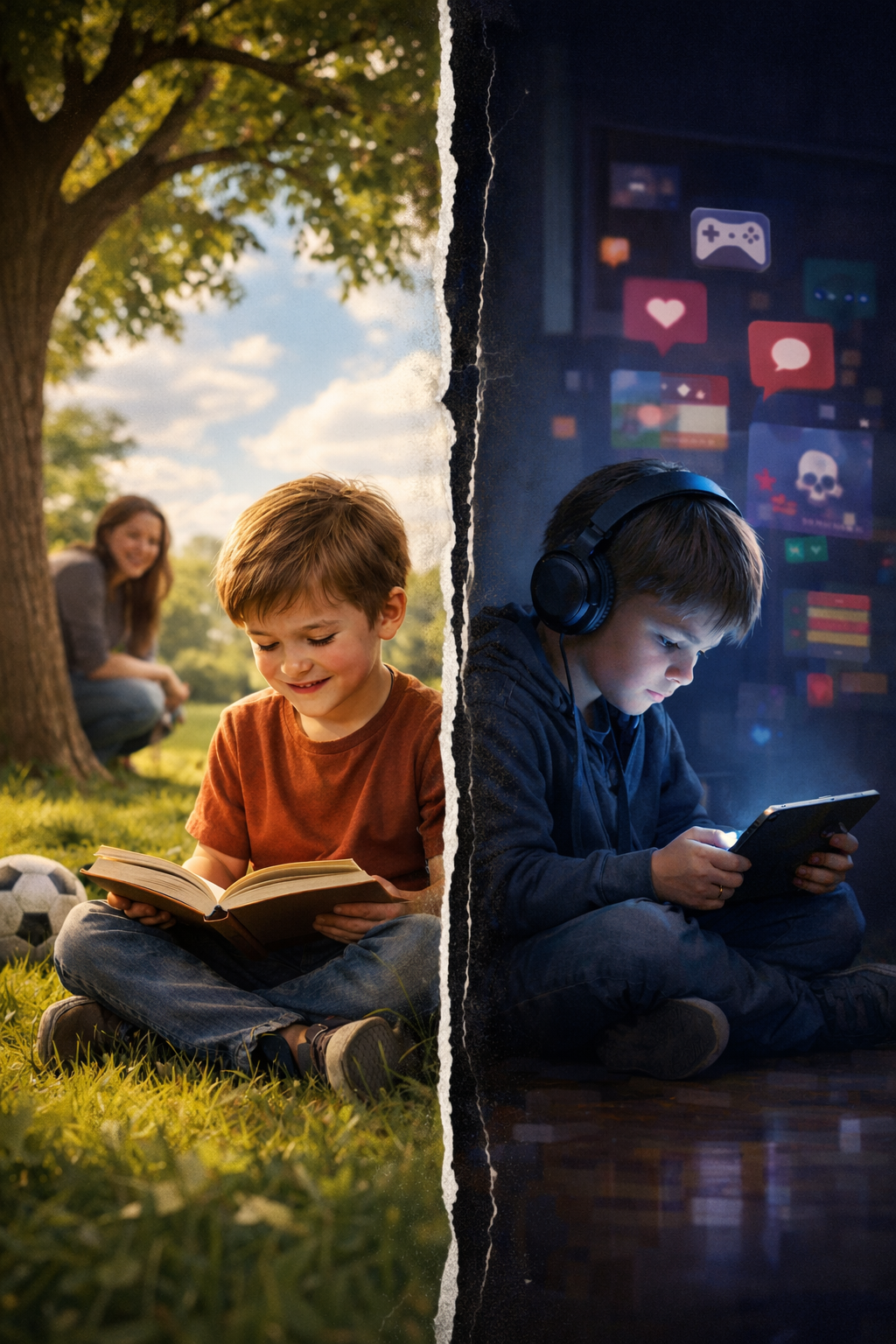
Thus the modern child is raised in two incompatible worlds: one real, one unreal.
The real world is sometimes harsh but always formative.
The digital world is endlessly stimulating but ultimately deforming.
And tragically, the unreal world is winning.
The child who once learned resilience from scraped elbows now learns passivity from endless scrolling.
The child who once discovered beauty in ordinary life now seeks meaning only in exaggerated spectacles.
The child who once discovered self-mastery through trial now discovers self-loss through addiction to fleeting images.
He is offered a thousand digital masks, but no true identity; a thousand entertainments, but no Truth; a thousand images, but no Incarnation.
We are raising a generation intimately familiar with the silly, the macabre, and the unreal, yet fundamentally unable to bear the weight of the ordinary and the true. To them, reality appears excruciatingly boring, almost offensive in its stability. What remains is a restless, insatiable yearning for the inane—a compulsive desire for trivial stimulation that erodes their capacity for authentic human experience.
And that, perhaps, is the most dangerous illiteracy of all.
I. The Digital Circus: Dopamine, Noise, and the Death of Contemplation
Our age has invented something more intoxicating than any ancient circus. The Romans gave the masses bread and amusements. Silicon Valley gives children glowing rectangles that shout with infinite voices and feed them invisible sweets.
Each meme is a jest without a jester, a punchline without a premise. Each micro-video is a flash of color that promises the extraordinary and delivers the absurd. And each swipe of the finger is a tiny liturgy of self-distraction, paying homage to the new god of perpetual novelty. The tragedy is not that children laugh at foolish things—children have always done that—but that they cannot now linger long enough to laugh at wise ones.
Dopamine, that little chemical cheerleader, jumps up and down like an overexcited child whenever something new happens on the screen. But like all overeager cheerleaders, it leaves the field exhausted and empty. The mind, habituated to fireworks, grows allergic to candles.
A book is a candle. A meme is a sparkler.
One burns slow and steady; the other burns fast and leaves a scorched mind.
II. The Vanishing Interior Life
Chesterton wrote that “the most extraordinary thing in the world is an ordinary man and an ordinary woman and their ordinary children.” But modern children are no longer permitted to be ordinary. Their mental diet consists almost entirely of the extraordinary: the bizarre, the sensational, the deviant, the unhinged, the abnormal, the freakish. They feast daily on what used to be exhibited in traveling carnivals—and do so without ever learning the comforting limits of reality.
Silence, that ancient tutor of Saints and Scholars, has been banished.
Boredom, that patient mother of creativity, is exploited in commercial opportunism.
Reflection, that gentle mirror of the soul, has been shattered into a thousand flashing fragments.
So children live perpetually at the surface of themselves, unable to descend into the depths where God whispers. Sacred Scripture, words upon words, becomes a bog: impenetrable, heavy, dry, intolerable and unintelligible. Prayer becomes impossible. Even the Holy Sacrifice of the Mass, which for centuries drew peasants and princes alike into the very courts of Heaven, now repels rather attracts a blistered mind schooled to crave unbroken bursts of sensation.
III. Education Without Wisdom, Stimulation Without Meaning
It is said that modern children know many things. This is quite true.
They know facts—but only in the sense that scattered pieces of information, drawn from fantasy and the fantastical, drift about their minds like fragments lost in a cloud of unknowing. In the medieval spiritual classic The Cloud of Unknowing, the anonymous author teaches that true knowledge of God requires piercing through the fog of distractions that obscure reality. Today’s children inhabit a different kind of cloud—not the holy darkness that leads the soul toward contemplation, but an artificial haze of images, trivia, and digital noise that prevents them from grasping anything solid, coherent, or real.
But they no longer know stories, which is far more damaging and dangerous.
A fact can be memorized by a machine; a story can only be understood by a soul.
Education was once a pilgrimage: the slow and reverent ascent of the mind toward the truth. Mortimer Adler reminded us that “the mind must be moved by desire and disciplined by effort if it is to rise to the level of understanding.”
But desire withers, and discipline collapses, when the mind is fed only stimulation and never substance—when it is trained to prefer motion over meaning.
The Queen of Formation—once enthroned upon books, contemplation, conversation, and the disciplined pursuit of wisdom—has now been dethroned and replaced. Her crown is measured in screen time; her kingdom reduced to unnumbered sedentary hours of neural activity that resembles not a pilgrimage but a scavenger hunt: a frantic race to collect snippets, clips, memes, and quotable ornaments. Children gather fragments but never form them; they accumulate information but never integrate it into Sophia. What should have been a feast of the intellect becomes a continual snacking of the mind, leaving the student simultaneously overstimulated and undernourished.
Adler warned that “the greatest disorder of our age is that we confuse being informed with being educated,”and the digital world intensifies this disorder by flooding the mind with unassimilated snippets often of the most inane sort.
Jordan Peterson notes that learning requires sequence of one thought leading to another the way footprints lead to a destination. But micro-media trains the brain to follow nothing, to stand still while images stampede across the mind. Adler foresaw this intellectual paralysis when he wrote that “true learning demands the ability to sit still with what is difficult long enough to let it speak.”Digital learning forbids such stillness. It offers the illusion of mastery without the friction of effort.
Thus the modern student is a paradox: encyclopedic yet empty, informed yet unformed, connected yet profoundly disconnected from meaning. He can summon vast quantities of material with a gesture, yet possesses no interior architecture sturdy enough to hold them together. His mind is a ransacked library without a librarian. He sees everything except what matters. He has gained the world of information and lost the soul of understanding—trading the slow fire of wisdom for the cold glow of data, and mistaking accumulation for insight, movement for mastery, and noise for knowledge.
IV. The Unmaking of a People: How Illiteracy, Spectacle, and Forgetfulness Cripple a Civilization
If this were only a private catastrophe, it would be tragic enough. But it threatens the very stability of the nation and the spiritual destiny of its people. St. Thomas Aquinas taught that “the soul is in some way all things” because the intellect is made to receive reality as it truly is. But what becomes of a people whose intellects no longer touch reality, whose souls are shaped not by being but by flicker, spectacle, and illusion?
Israel, too, once forgot its story—“They soon forgot His works and would not wait for His counsel” (Ps 106:13). A civilization begins to die not when it is conquered from without, but when it forgets from within.
Aquinas warns that “the intellect is perfected by turning toward things intelligible.”
Our culture trains the young to turn endlessly toward the unintelligible. A nation that forms its children to be incapable of truth necessarily forms them to be incapable of freedom.
1. A People Without a Past
A people that cannot read cannot remember.
Children untrained in reading are strangers to their own history.
Their past becomes a rumor. Their heritage becomes a meme.
Their saints and heroes become punchlines or footnotes.
Like Israel in the days of the Judges—“Every man did what was right in his own eyes” (Judg 21:25)—a storyless people becomes an anchorless people.
Without memory, there is no identity; without identity, no destiny.
A people without a story is a people without a future.
2. The End of Rational Politics
Democracy assumes citizens who can read, who can follow a chain of reasoning from premise to conclusion. Replace reasoning with reaction, and you replace democracy with digital mob rule. Chesterton warned that the danger is not that modern people believe too much, but that they believe anything. What becomes of a nation when its political literacy is formed primarily by 19-second clips crafted by anonymous, faceless algorithms?
You get a polity that legislates by emotion, governs by accusation, and chooses leaders based on who best manipulates the algorithm. Like ancient Israel clamoring for a king “to be like the nations” (1 Sam 8), we choose not the wise, but the entertaining; not the just, but the sensational; not the virtuous, but the viral.
3. The Triumph of the Abnormal
Children raised on digital spectacles come to believe that normal life is meaningless,
ordinary morality outdated, and the bizarre the true measure of authenticity.
Why cherish family life when the screen glorifies only the sensational?
Why practice virtue when vice is retweeted into celebrity?
Why trust the Church when influencers offer the counterfeit glow of instant enlightenment?
This is not mere cultural confusion: it is cultural replacement.
Aquinas teaches that the intellect is corrupted when it cleaves not to reality but to “phantasms.” We are forming children not merely to imagine fantasies, but to dwell in them as if they were true, real, good. As Israel followed Baal because His cult was more exciting than fidelity to the living God, so our age enthrones novelty over truth.
4. The Collapse of Authority
Parents cannot compete with machines that entertain.
Teachers cannot compete with devices that distract.
Priests cannot compete with algorithms that promise instant gratification.
When the Church speaks in a still, small voice, but the phone screams with carnival noise, the child obeys the carnival.
And as Aquinas teaches, the will follows the intellect: what the mind judges as good, the heart pursues. Hearts misshaped by spectacle cannot recognize the Good when He stands before them. Like Israel turning away from the prophets to listen instead to false seers,
our children prefer the sweet poison of digital prophets who promote everything and demand nothing.
5. A Workforce Unfit for Reality
Employers increasingly meet young adults who can multitask on five screens but cannot follow a single set of instructions. They swipe quickly but cannot think deeply and do deep work. They perform a thousand micro-tasks but cannot endure a moment of monotony.
A society built on instant gratification produces workers who cannot endure any delay.
And a generation that cannot endure delay cannot endure suffering.
And a generation that cannot endure suffering cannot endure freedom.
Israel in the wilderness murmured because manna arrived one day at a time;
our children murmur because dopamine does not arrive one second at a time.
6. A Generation Unreachable by God
When a child cannot bear stillness, he cannot bear prayer.
When he cannot read, he cannot meet Christ Our Lord in Holy Scripture.
When he cannot follow a story, he cannot grasp salvation history.
When he cannot sit still, he cannot contemplate the Holy Sacrifice of the Mass.
Aquinas wrote that “the highest operation of man is the contemplation of the truth.”
But contemplation requires silence, stillness, and interior order.
We are raising souls who cannot ascend the mountain
because they cannot stop scrolling long enough to take a single step.
Like Israel at Sinai, they wander below the mountain, fashioning digital idols,
while the Voice that would speak to them is drowned out by the frenzy of their own making.
And unless we intervene, the next generation may never hear that Voice again.
V. The Catholic Answer: Re-teaching the Human Being
Holy Mother Church once saved civilization when barbarism swept across Europe.
She did it not merely with candles and manuscripts but with stories—
stories that named the world, revealed the soul, and taught the art of being human.
She must do so again.
For if algorithms have become the new catechists, then Catholic literature must reclaim its ancient role as the furnace in which the imagination is purified, ordered, and set aflame.
Walker Percy’s alienated seekers, Flannery O’Connor’s violent visitations of grace, Tolkien’s mythic cosmos, Greene’s tortured saints, and Waugh’s hard-won redemptions offer what digital culture cannot: an encounter with reality that exposes illusion, reveals sin, and makes grace luminous. These writers do for the modern soul what monks once did for Europe: they rebuild the interior world.
1. Restore the Primacy of the Word
Put real books into the hands of children, books with weight and spine and dignity.
Teach them Scripture as story, not slogan.
Let them meet Augustine and Aquinas, who thought deeply because they prayed slowly.
But do not stop there:
- Walker Percy’s The Moviegoer confronts the consumerized soul that wanders through life unable to “see” reality. Children who read Percy learn to recognize their own spiritual malaise and the remedies hidden in ordinary things.
- Flannery O’Connor’s A Good Man Is Hard to Find and “Revelation” teach that grace is fierce, disruptive, and often appears in the moment when illusions collapse. Her fiction is a form of spiritual shock therapy for a sentimental age.
- Tolkien’s The Lord of the Rings shows the sacramental texture of creation—
that pity can save the world, that evil cannot create, that ordinary people carry great destinies. A child who loves Middle-earth learns courage, humility, and hope. - Graham Greene’s The Power and the Glory depicts the mystery of grace at work in the weakest of His servants (a theology of brokenness digital perfectionism cannot comprehend).
- Evelyn Waugh’s Brideshead Revisited unveils the quiet, relentless pursuit of God through memory, beauty, and homecoming. No algorithm can teach what Waugh reveals: that grace is patient and polite, but unstoppable.
A child formed by such works does not merely read—he awakens.
2. Rebuild the Muscle of Attention
Make silence normal again.
Make boredom permissible again.
Make reading daily again.
Make screens temporary again.
Attention is a moral discipline before it is an intellectual one.
No one reads Brideshead Revisited quickly.
No one races through The Moviegoer without reflection.
No one skims Tolkien and understands what they have read.
No one absorbs O’Connor or Greene without wrestling.
Great Catholic literature requires—and rebuilds—the very capacities digital culture destroys: stillness, reflection, interiority, humility before meaning.
3. Teach Digital Asceticism
The early monks fled to deserts of sand.
Today’s families must flee to deserts of silence.
Not permanently, but regularly, rhythmically, intentionally—
the way Tolkien’s heroes retreat to Rivendell for counsel,
or the way Percy’s characters seek moments of piercing clarity
in a world that numbs the mind and soul.
We do not reject the digital world.
We merely refuse to let it rule us.
Asceticism is simply the recovery of self-command: the ability to choose what is good over what is stimulating.
4. Restore Wonder Through Reality
Show children the stars, not just the screens.
Give them gardens to tend, instruments to play, Saints to love, Sacraments to behold.
Flannery O’Connor insisted that “the real world has a smell.”
Tolkien taught us that creation is charged with divine echoes.
Greene and Percy remind us that salvation history unfolds in ordinary lives.
Let children taste the texture of reality again.
A child who discovers wonder in creation will not bow to an algorithm.
5. Recovering the Great Books: Mortimer Adler and the Return to Real Education
Mortimer J. Adler understood what the Church has always proclaimed:
that human beings are formed not by information, but by conversation with the great minds of the ages.
When he created The Great Books of the Western World and spearheaded the Paideia Program and Great Books seminars, his aim was simple and profoundly Catholic in spirit: to teach people—ordinary people—to read carefully, think deeply, argue honestly,
and contemplate truth together.
Adler insisted that:
- “Reading is not passive; it is an intellectual exercise requiring active engagement.”
- “All genuine learning comes through the labor of the mind.”
- “The great books teach not what to think, but how to think.”
Catholic schools, high schools, and colleges can rebuild civilization
simply by returning to these practices:
a. Restore the Seminar Table
Replace worksheets with conversations.
Replace screens with Socratic dialogue.
Replace memorization with the shared pursuit of Truth.
b. Build Reading Programs Around Whole Books, Not Fragments
Teach The Odyssey, The Confessions, The Lord of the Rings, Brideshead Revisited, The Power and the Glory, and selections from Percy and O’Connor—not summaries, excerpts, or “clips.”
c. Form Teachers as Intellectual Shepherds
Adler understood that teachers need not be experts in everything;
they must be experts in guiding minds. Great teachers lead students not to answers, but to wonder.
d. Restore the Human in the Humanities
When students read whole books, discuss real ideas, and wrestle with great questions,
they encounter truth not abstractly but personally. This is the foundation of virtue and the safeguard of civilization.
A culture that reads deeply cannot be ruled by algorithms.
A people who converse with the great books cannot be enslaved by digital noise.
A Church that forms imaginations through beauty and truth will raise saints.
Adler’s vision and the Catholic literary tradition together offer the antidote to our crisis:
the restoration of the human person through story, reason, and grace.
Conclusion: Extreme Illiteracy and the Battle for Reality
The crisis we face is not ordinary illiteracy but Extreme Illiteracy—a condition far more devastating than the inability to read words. It is the inability to read reality itself. A child may hold the world’s entire storehouse of information in the palm of his hand, yet remain blind to truth, deaf to meaning, and numb to beauty.
This is the tragedy—and the terrible irony—of our age:
we have built a civilization where children can access everything, and yet understand nothing.
A generation raised on screens is slowly losing the ability to encounter creation, to inhabit a story, to seek wisdom, to hear God. They prefer, like the citizens of The Matrix, a simulated world of curated stimulation rather than the hard, glorious reality for which they were created. They do not merely escape into fiction; they reject reality itself. And when a people rejects reality, they inevitably reject the God who made it.
Extreme Illiteracy is the death of the interior life.
It is the collapse of contemplation.
It is the disintegration of memory, imagination, and reason.
It is a wound inflicted on this generation—and, unless we intervene, a curse passed on to the next.
Digital culture has become the new oracle, the new catechist, the new master of souls.
Its algorithms train children not to think but to react, not to contemplate but to consume.
It promises omniscience while delivering amnesia; it promises connection while producing isolation; it promises empowerment while forming a generation that cannot command even its own attention.
This is not merely a cultural crisis—it is a moral one, a spiritual one, a civilizational one.
Scripture warns repeatedly that when a people forgets its story, it loses its identity and becomes enslaved to false gods.
“My people perish for lack of knowledge,” cries the prophet Hosea (Hos 4:6).
Aquinas teaches that the intellect is ordered to reality; therefore, a mind habituated to unreality becomes incapable of truth and a soul incapable of truth becomes vulnerable to lies.
Peterson warns that attention determines destiny.
Haidt warns that overstimulation destroys attention.
The Church warns that the soul was made for God, not for distraction.
These voices converge on a single, terrifying truth:
A generation that cannot attend cannot believe.
A generation that cannot read reality cannot receive Revelation.
A generation that cannot be silent cannot be saved.
If we do not reclaim our children’s minds now—through prayer, discipline, great books, silence, sacramental life, and the renewal of the Catholic imagination—they will inherit a world they cannot understand and cannot survive.
A world where citizens live as consumers,
where souls live as avatars,
where families dissolve into entertainment,
where Truth becomes intolerable,
and where the human story collapses into digital noise.
But there is hope—real, Catholic, Incarnational hope.
We can still choose the harder path:
the path of discipline, contemplation, Catholic literature, and the Great Books;
the path of attention, interiority, and silence;
the path of sacrament, story, and Scripture;
the path of truth over spectacle, and reality over simulation.
For in saving the attention of our children, we save the future of our families, our Church, and our civilization. And perhaps—by God’s grace—we save the human story before it is swallowed by the counterfeit world our age mistakes for reality.
Let us therefore fight against this Extreme Illiteracy,
with the confidence of the saints,
the courage of our ancestors,
and the conviction that truth—however quiet—remains stronger than noise.
For the Real World is still God’s world.
And nothing in the algorithm can overcome the Word made Flesh.
Postscript: Author’s Note
“Do not be conformed to this world, but be transformed by the renewal of your mind.”
— Romans 12:2
This article was written as both a warning and a plea. The forces now shaping the minds of children are unprecedented in speed, scale, and spiritual consequence. Our task—as parents, educators, citizens, and Catholics—is nothing less than the renewal of the human mind, rooted in Truth, protected by silence, strengthened by great books, purified by Beauty, and elevated by Grace.
May we choose the ancient paths—
the path of Scripture,
the path of the Saints,
the path of the Word made Flesh—
and thereby safeguard the interior lives of our children.
“Stand at the crossroads and look; ask for the ancient paths,
ask where the good way is, and walk in it,
and you will find rest for your souls.”
— Jeremiah 6:16
AI-Assisted Research Acknowledgment:
ChatGPT (GPT-5) provided research support, editorial suggestions, and structural refinement for portions of this article at the author’s direction. All final content, theological judgment, and interpretive conclusions are the author’s own.
— Professor Timothy J. A. O’Donnell
From Magisterium.AI
Accessed 12.10.2025
Conclusion
“Extreme Illiteracy” is a theologically sound and timely contribution, orthodox in its defense of human dignity, moral formation, and spiritual renewal against cultural fragmentation. It faithfully draws from Catholic sources—implicitly Scripture, Tradition, and magisterial emphases on contemplation and education—to call for a return to reality as God’s world, culminating in the Word made Flesh. By promoting great books, asceticism, and sacraments as remedies, it invites readers to deeper communion with Christ, embodying the Church’s mission to sanctify culture. This essay could serve well in catechetical or homiletic contexts, encouraging families and educators to foster souls attuned to truth and beauty.
Source Note: This editorial was developed with the assistance of ChatGPT (GPT-5) to support research, structure, and stylistic refinement from a traditional Catholic perspective.