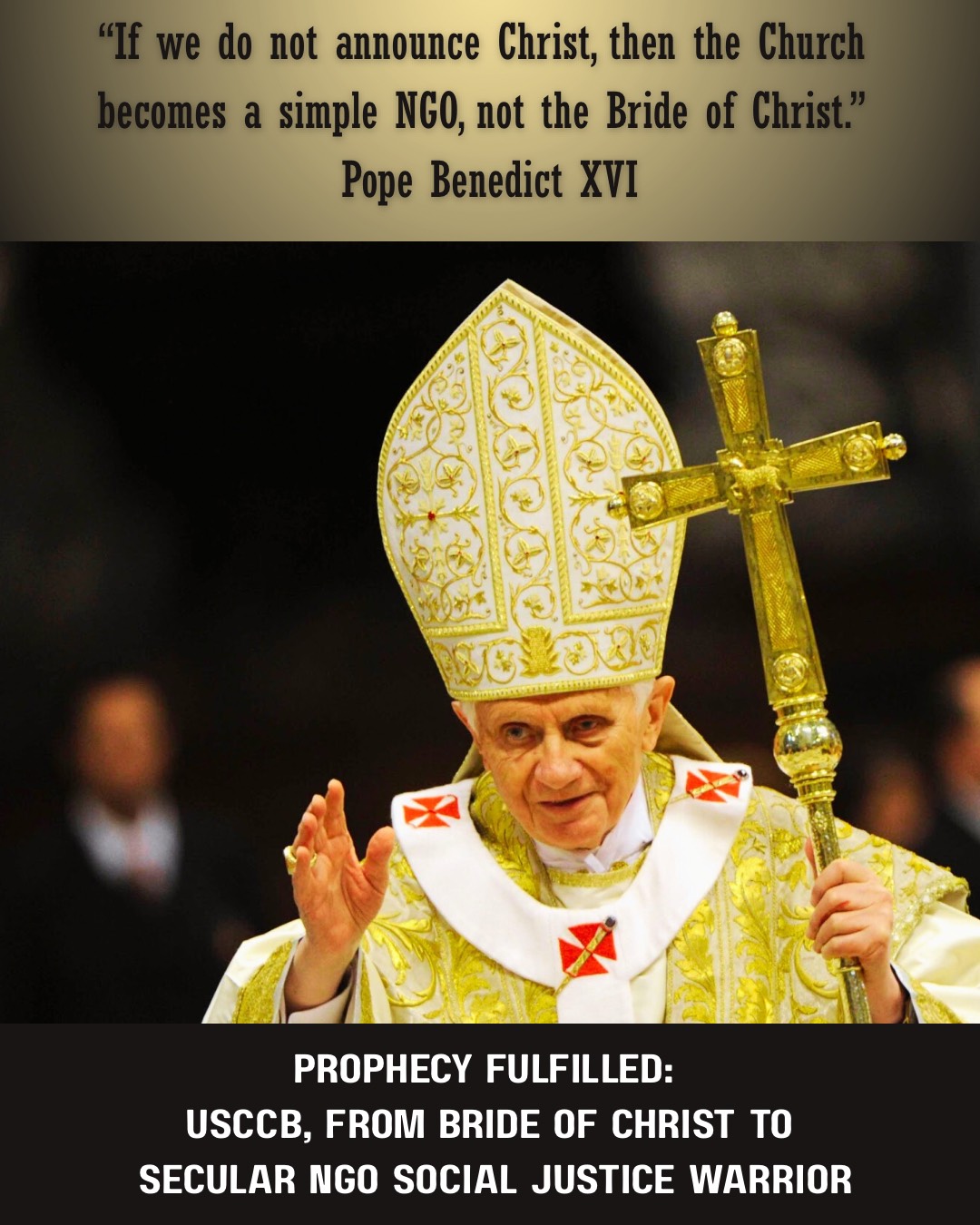
Catholic tradition, from the Catechism to Popes Pius XII, John Paul II, and Benedict XVI, has always taught both the duty to welcome migrants and the equal duty of nations to regulate their borders for the sake of the common good; open-border ideology is therefore contradicts, rather than fulfills, authentic Church teaching. The uncontrolled influx of millions of illegal immigrants in recent years has produced grave evils: 400,000+ unaccompanied minors lost in the system, record fentanyl deaths, surging human trafficking and sexual exploitation, violent crime by criminal aliens, and massive welfare strain on American citizens—harms that ordered charity seeks to prevent, not enable. The USCCB along with Pope Leo have nonetheless become aggressive institutional opponents of the current U.S. Presidential administration’s efforts to restore border enforcement and carry out lawful deportations, routinely denouncing these measures as “inhuman” while rarely acknowledging the social chaos and moral disorders that lax borders have unleashed. This one-sided advocacy is rendered still more problematic by the bishops’ historic dependence on hundreds of millions of dollars in annual federal grants tied to migrant and refugee services, a financial entanglement that Professor Timothy O’Donnell points out that Benedict XVI warned, risks turning the Church into a mere NGO and compromising her prophetic freedom. True Catholic charity, modeled by St. Nicholas himself, is therefore not indiscriminate but prudent and ordered: it protects the household (the nation) first so that it remains capable of protecting the vulnerable stranger, rather than dissolving the household under the illusion that the absence of boundaries equals mercy.
– CUP Chair, Vicki Yamasaki
I. Introduction: St. Nicholas and the Boundaries of Charity
In every generation, the Church gives us models of charity whose lives illuminate the moral challenges of their age. St. Nicholas, the patron saint of children, families, travelers, and the endangered, stands as one of the most beloved examples. His generosity is legendary, yet too often we overlook an essential feature of his witness: his charity was ordered, prudent, and rooted in a deep sense of responsibility for the flock entrusted to him.
Nicholas lived during a time of social instability, political fragmentation, and great human need. He gave generously but never recklessly. His gifts were not distributed indiscriminately; they were entrusted to families whose welfare he knew, whose dignity he protected, and whose children he sought to safeguard from exploitation. He understood that true charity flourishes only within a community capable of protecting the vulnerable.
A bishop in the early Church was not simply a spiritual leader but a guardian of the common good. St. Nicholas defended his people, especially the poor and innocent, not only through almsgiving but through vigilance, justice, and the preservation of moral order. He knew that unprotected households invite predators, just as unguarded cities invite disorder.
This ancient insight bears directly on our contemporary immigration crisis.
Like the families of Myra whom Nicholas served, a nation is a household. It has doors—doors that can be opened in welcome, but also closed for protection. Without doors, a house is not hospitable; it is vulnerable. Without borders, a nation cannot exercise the ordered charity St. Nicholas embodied.
Invoking St. Nicholas, therefore, should not lead us into sentimentalism but into a recovery of the true Christian understanding of charity: a love disciplined by prudence, animated by justice, and grounded in the common good. His life reminds us that defending one’s own people and culture is not contrary to Christian mercy, it is a precondition for it. Only when a household is stable can it welcome the stranger; only when a nation is secure can it extend meaningful compassion.
With St. Nicholas as our guide, we can approach the immigration question not with ideology or emotionalism, but with the ordered, mature charity that the Church has always taught.
Catholic tradition has long upheld the dignity of every human person, including migrants, refugees, and those seeking better lives for themselves and their families. Yet just as firmly, the Church has affirmed the moral legitimacy of political borders and the duty of nations to regulate immigration for the sake of the common good. These two principles of human dignity and national sovereignty are not in conflict but are complementary aspects of the Church’s vision for political and social order.
In today’s political discourse, however, much of this balanced teaching is lost. Immigration is often treated with emotionalism rather than prudence, with slogans rather than sound moral reasoning. A faithful Catholic perspective must reject both the extremes of xenophobia and the naïveté of open-border ideology. Order is the precondition for charity, and a nation must first exist as a coherent moral community before it can offer meaningful hospitality.
II. Catholic Teaching: Rights of Migrants and Rights of Nations
The Church’s position is clearly articulated in the Catechism of the Catholic Church, which holds both that migrants should be treated with charity and justice, and that nations have the right to regulate immigration:
“The more prosperous nations are obliged, to the extent they are able, to welcome the foreigner… Political authorities may, however, regulate migration in the light of the common good.”¹
Vatican II affirmed the rightful competence of political authority in maintaining social order and security, noting that the common good is the foundational justification for civic authority.² Pius XII writing during a period of massive global displacement taught that while migration can be necessary, states retain the right to structure immigration in accordance with their lawful order.³
St. John Paul II, whose writings are frequently cited selectively in immigration debates, insisted with clarity:
“The State has the right to regulate migration flows and to defend its borders, always respecting the dignity of the human person.”⁴
John Paul II viewed nations as moral communities—repositories of culture, duty, identity, and responsibility—and therefore deserving of juridical protection.⁵
III. Roger Scruton: Why Borders Matter for Civilization
Philosopher Roger Scruton, one of the foremost defenders of the nation-state in the modern world, argued that borders are not arbitrary lines but essential features of communal life. They make possible the shared culture, law, and loyalty that enable a society to flourish and to welcome newcomers.
Scruton wrote: “A nation is a place where strangers find that they are already at home. But this presupposes a shared loyalty, a common culture… these cannot survive if borders are treated as mere lines on a map.”⁶
For Scruton, borderlessness is not compassion—it is dissolution. It erodes the very conditions that make meaningful solidarity possible.
IV. The Crisis of Open-Border Ideology
In recent decades, the ideology commonly labeled “open borders” has gained traction among activists, political operatives, and even within some Catholic institutions. This ideology collapses the complexity of immigration into an abstract moralism that disregards the realities of sovereignty, culture, economics, and public safety.
- The Church Does Not Teach Open Borders
While the Church urges generosity toward migrants, she is explicit that states retain the right—and the duty—to regulate immigration.
Pope Benedict XVI affirmed that states must guarantee the security and coherence of their societies: “The State… must guarantee the security of society.”⁷
The Compendium of the Social Doctrine of the Church is equally clear: “Nations have the right to regulate migration flows and to defend their own territory.”⁸
Open borders, therefore, are not a Catholic teaching; they are a political ideology incompatible with the Church’s doctrine on the common good.
- Moral and Social Consequences of Open Borders
The effects of open-border policies (or policies that functionally approximate them) are severe:
- Human trafficking increases, as cartels profit from exploiting migrants.
- Women and children face grave abuses on journeys facilitated by lawlessness.
- Cities and local governments collapse under population surges they cannot financially sustain.
- Social trust declines, replaced by resentment and instability.
- Low-income workers experience downward wage pressure due to illegal labor competition.
- Criminal organizations flourish, embedding themselves in communities.
The Church’s preferential option for the poor includes American citizens, whose lives are destabilized when the rule of law is compromised.
- Disorder Is Not Mercy
Catholic theology teaches that peace is the tranquility of order. Thomas Aquinas makes clear that charity itself depends on ordered relationships and just structures.¹⁰ A society that cannot control its borders forfeits the ability to maintain the order required for charity to function.
To insist on lawful, orderly immigration is not a rejection of charity; it is the precondition for its possibility.
V. A Critical Look at the USCCB: Compassion or Compromise?
Many faithful Catholics view the U.S. Conference of Catholic Bishops’ approach to immigration with increasing concern. While grounded in sincere pastoral desire, the USCCB’s advocacy often appears incomplete, partisan, or influenced by structural incentives.
- Selectively Quoting Church Teaching
The USCCB highlights the Church’s call to welcome migrants but seldom emphasizes the equally authoritative affirmations of sovereign rights, border control, and the common good. This selective presentation creates a distorted moral narrative incompatible with the full breadth of Catholic social doctrine.
- Protests Against Law Enforcement
Certain bishops have participated in protests aimed not at reforming unjust laws but at opposing the enforcement of existing ones. This activism aligns more with political movements than magisterial teaching.
- Massive Federal Funding and Structural Compromise
The USCCB and its affiliated agencies, including Catholic Charities, receive hundreds of millions of dollars annually in federal grants connected to immigration services and refugee resettlement.¹¹ As the analysis in From Altar to Activism shows, such extensive financial entanglement can subtly reshape institutional priorities and orient ecclesial advocacy toward the expectations of federal funders.¹⁶ While the humanitarian mission is real, the resulting dependency creates a structural conflict of interest. And as Benedict XVI warned, when the Church becomes too entangled with state funding, Holy Mother Church risks functioning as merely an NGO, losing Her prophetic freedom.¹² Thus, the bishops’ political advocacy must be viewed within the context of material incentives that naturally influence institutional behavior.
VI. A Prudential Catholic Framework for Just Immigration
A truly Catholic approach to immigration is neither ideological nor sentimental. It is grounded in the Natural Moral Law, illuminated by the Church’s social doctrine, and guided by the classical virtue of prudence, which St. Thomas Aquinas calls “right reason applied to action.”¹⁷ Prudence enables the state to balance mercy with justice, compassion with order, and generosity with the stability required for the common good.
Catholic teaching does not propose borderless idealism. Instead, it offers a moral framework rooted in reason, revelation, and the nature of political community.
- Sovereignty and the Natural Moral Law
According to the Natural Moral Law, political society exists to secure the common good, a good that includes order, peace, moral formation, and cultural coherence. A nation’s sovereignty is not merely a legal arrangement; it is a moral responsibility.
Jacques Maritain emphasizes the centrality of this duty: “The body politic has the moral duty to safeguard the conditions without which the common good cannot be achieved.”¹⁸
For Maritain, this duty includes the right of the state to regulate immigration, not as an act of exclusion, but as an exercise of justice ordered toward preserving the community’s integrity.
Maritain further warns against confusing compassion with political disorder: “Humanitarian sentiment becomes destructive when it dissolves the structures that sustain civic friendship and the rule of law.”¹⁹ While Étienne Gilson, another master of Thomistic philosophy, underscores that political society is natural to man and must be protected accordingly: “Society is not the enemy of the person but its necessary condition. To endanger the order of society is to endanger the dignity of the person.”²⁰ From the perspective of Natural Law, therefore, border regulation is not a denial of dignity; it is an act of stewardship toward the persons already entrusted to the state’s care.
- Mercy Toward Those in Genuine Need
Catholic teaching requires compassion toward refugees and those fleeing grave injustice. Yet mercy must be disciplined by justice, for justice protects both the migrant and the receiving community. Maritain insists that authentic mercy never disregards the moral structure of political life: “Mercy must not destroy the framework of justice, for without justice mercy becomes false charity.”²¹
Prudence demands that legitimate political authority—rather than activists or ecclesial bureaucracies—discern who is genuinely in need and how they can be integrated without undermining social stability.
- The Necessity of Assimilation
Assimilation ensures that newcomers enter into the cultural, linguistic, and moral universe of the host nation. It is a process of mutual enrichment, not erasure.
St. John Paul II, acknowledging the moral importance of national cultures, wrote:
“A nation is primarily a community of culture. It is through culture that a people safeguards its identity and transmits it to future generations.”²²
Assimilation therefore protects both the immigrant—who gains true belonging—and the host community, which maintains coherence.
Gilson affirms that a shared moral and cultural grammar is essential for the stability of social life “Where men do not share common meanings, they cannot share a common life.”²³
Assimilation is thus an act of charity toward migrants, enabling them to participate fully in the social, moral, and civic goods of the nation.
- Prioritizing the Family and Avoiding Perverse Incentives
The Church has long affirmed that the family is the primordial cell of society, the first school of virtue, and the indispensable foundation of every just social order. Immigration policy, if it is to be genuinely humane, must honor this truth by refusing to create conditions that lure families into perilous journeys, tear husbands from wives and parents from children, or expose vulnerable women and minors to the predation of traffickers.
Prudence therefore demands policies that foster lawful, secure, and orderly avenues of migration, avenues that safeguard the unity of the family and uphold the dignity of those who seek refuge or opportunity, rather than drawing them into the shadows of chaos and danger.
- Defense of the Common Good
A government’s first moral obligation is to its own citizens—especially the poor, who disproportionately suffer from wage suppression, job displacement, and the strain on schools, hospitals, and local infrastructure.
St. Thomas affirms that political responsibility is intrinsically ordered: “The ruler must prioritize the common good of the community over the good of individuals.”²⁴
This includes the right—and obligation—of nations to regulate immigration in ways that safeguard public order, protect workers, and preserve social trust.
A nation that cannot preserve its own common good cannot sustain anyone else’s.
VII. Conclusion: Charity Requires Truth, and Truth Requires Order
Catholics must firmly reject the false and destructive binary that pits open borders against hostility toward migrants. The Church proposes a richer and far more demanding vision—one rooted in the Natural Moral Law, illuminated by the wisdom of the philosophical tradition, and shaped by a mature understanding of political responsibility. Within this vision, nations possess rights, migrants possess rights, and the virtue of prudence governs their relationship by harmonizing justice, mercy, and the common good.
St. John Paul II reminds us that national communities are not arbitrary constructs but moral realities rooted in culture, memory, and shared responsibility: “The nation is… the great community of persons… and the nation has a fundamental right to existence.”¹⁴ This right is not merely historical or cultural; it is grounded in the very structure of the human good.
Roger Scruton echoes this insight from the standpoint of political philosophy, warning that “A society that cannot defend its borders will not long survive to defend anything else.”¹⁵ A nation that abandons sovereignty abandons the moral framework necessary to sustain ordered liberty, protect families, and extend meaningful hospitality to those in need.
Thus the path forward is not the sentimentality of borderless idealism, nor the cruelty of indifference, but ordered charity—a charity disciplined by truth, guided by prudence, fortified by sovereignty, and animated by genuine mercy. Only upon such foundations can a nation welcome the stranger without dissolving the very household into which he seeks entry. Only upon such foundations can Catholics witness faithfully to both the dignity of the migrant and the indispensable goods of cultural stability, lawful order, and the common good.
Footnotes
- Catechism of the Catholic Church (1997), §2241.
- Vatican II, Gaudium et Spes (1965), §74.
- Pius XII, Exsul Familia (1952), §§30–34.
- John Paul II, “Message for World Migration Day,” 1996.
- John Paul II, Memory and Identity (New York: Rizzoli, 2005), 66–72.
- Roger Scruton, Where We Are: The State of Britain Now (London: Bloomsbury, 2017), 45.
- Benedict XVI, Caritas in Veritate (2009), §41.
- Pontifical Council for Justice and Peace, Compendium of the Social Doctrine of the Church (2004), §298.
- Intentionally omitted per user request (formerly Francis reference).
- Thomas Aquinas, Summa Theologiae, II-II, q. 29, a.
- U.S. Government Accountability Office, “Federal Funding to Religious Immigration Service Providers,” annual reports.
- Benedict XVI, Homily at Mass in Freiburg, September 25, 2011.
- Compendium of the Social Doctrine of the Church, §297–298.
- John Paul II, Memory and Identity, 70.
- Roger Scruton, How to Be a Conservative (London: Bloomsbury, 2014), 112.
- Corpus Christi for Unity and Peace. “From Altar to Activism: How Federal Funding Reshapes Catholic Witness.” Accessed December 6, 2025. https://www.corpuschristiforunityandpeace.org/altar-to-activism/.
- Thomas Aquinas, Summa Theologiae, II-II, q. 47, a. 1
- Jacques Maritain, Man and the State (Chicago: University of Chicago Press, 1951), 10.
- Jacques Maritain, The Person and the Common Good (Notre Dame, IN: University of Notre Dame Press, 1966), 56.
- Étienne Gilson, The Christian Philosophy of St. Thomas Aquinas (Notre Dame, IN: University of Notre Dame Press, 1994), 276.
- Maritain, The Person and the Common Good, 61.
- John Paul II, Memory and Identity (New York: Rizzoli, 2005), 67.
- Étienne Gilson, The Unity of Philosophical Experience (San Francisco: Ignatius Press, 1999), 12.
- Thomas Aquinas, Summa Theologiae, I-II, q. 90, a.
- Source Note: This editorial was developed with the assistance of ChatGPT (GPT-5) to support research, structure, and stylistic refinement from a traditional Catholic perspective.